Showing posts with label soundtracks. Show all posts

Tuesday, March 15, 2011

The Cult of Jerry

It's no secret that I'm a big fan of Jerry Goldsmith.

Today, I took a stab at answering a question asked by Jim Lochner over on his blog: why does there seem to be a Cult of Jerry?

Here's my reply - Examining the Cult of Jerry.

Tuesday, February 22, 2011

Battlestar Galactica soundtrack review

I wrote up an extremely self-indulgent review of Intrada's Battlestar Galactica.

Hope you can take a moment to read through it.

Thursday, February 10, 2011

Thursday, May 27, 2010

The Hardest Choice of All

I don't know how I got the money. Saving up from allowances maybe. Hard to recall that detail all these decades later.

What I do remember is the decision. The difficult decision, almost impossible to make. Standing between the two rows and having to decide: which will be my first record album.

I'd purchased and received some singles over the years: Popcorn and Last Train to Clarksville and A Cowboy's Work is Never Done among others. But I did not own an LP.

I now had the money but I had to decide, what was it going to be? My tastes were odd, I think, even for the early seventies. The first song I taped off the radio onto cassette was Also Sprach Zarathustra, Deodato's jazzy version of the theme from 2001 A Space Odyssey. Later recordings on that same cassette included themes from TV shows (such as The Time Tunnel) recorded by shoving the microphone up to the television speaker. Yes, my preference for film & tv scores manifested early.

But in the aisles of Richman-Gordman that day, I knew nothing of soundtrack albums, just the pop records filling the bins. So I had to choose. I wanted an album that contained songs I knew, and I had it narrowed down to two artists: The Carpenters or Olivia Newton John.

I still recall moving back and forth between them, checking out the contents of the records, trying to decide, trying to decide. I loved Have You Never Been Mellow and Please Mister Please and Olivia was, well, really really cute. But the Carpenters had Close to You and We've Only Just Begun -- and both songs on the SAME record.

I took the albums out of the bins. I gazed into Olivia's eyes, so magical, so inviting. And I bought The Carpenters. And I loved it. For many years, their version of Help! was the only one I knew.

My second LP was probably Westworld, found in a cut-out bin at a discount store. Or it may have been Live and Let Die. Either way, it was movie music. Pop radio had already lost its tenuous grip on me.

I still own that Carpenters LP. I may go drag it out right now.

Tuesday, February 2, 2010

The Burbs

I paid good money to see The Burbs in the theater. When it was over, I wanted my money back. And my time.

The Burbs came out the year after Big. It was THE NEXT TOM HANKS MOVIE (I think Punchline was the next movie production-wise, but it got held back. I saw it at a preview sometime after The Burbs. At least this is how I remember it 2 decades later.) Anyway, anticipation ran high for The Burbs due to the charm of both Hanks and the movie Big. Plus it had Carrie Fisher in it, always a boon to big Star Wars nerds like me.

(By the way, does anyone else recall in 1988-89ish when Starlog printed a story titled something like "Is Star Wars Fandom Dead?")

Anyway, expectations were high. But The Burbs fell flat. Labored and unfunny, I remember little about the film except that i was bitterly disappointed.

I knew nothing about the Varese Sarabande Soundtrack Club (original incarnation) until after it died, so the initial release of the soundtrack completely passed me by. I eventually heard the End Titles on the Varese 25th Anniversary set and it didn't really strike me as anything extraordinary. It has a pleasant enough tune, with a goofy Patton pastiche and then the "hilarious" whistle stuff at the very end. in short, it didn't make me want to fork over the big bucks for the out of print club cd.

Then the expanded edition came out.The Burbs: Deluxe Edition

I ordered it, caught in a wave of Jerry-mania. My expectations were again high. Here was music that fetched a high dollar on the resale market, so it had to be good, right?

Lesson learned. Sometimes a CD is scarce for a good reason.

This score left me flat, just like the movie, It's Jerry in his mickey-mousing comedy mode, which is hardly Jerry at his best. Goldsmith and comedy generally never went well together. And this movie, which strove to be both weird and funny, didn't even benefit from a fabled "Jerry scored the ideal movie in his head rather than the crappy movie in reality" boost. It's just as labored and unfunny as the film it accompanied. Really, the End Titles neatly sums up the entire score. Everything you'd ever really want from The Burbs is contained in that suite.

So if you're one of those just now getting into Jerry and kicking yourself for missing the now sold-out deluxe edition, don't worry. You're not missing anything. It's just another bottle cap in my collection and one I rarely dig out.

Wednesday, January 13, 2010

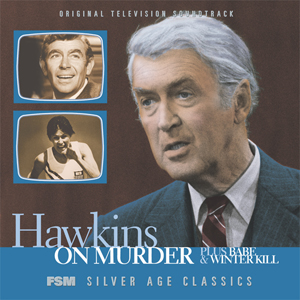
Hawkins. Goldsmith. Brilliant.

I've never seen the TV show Hawkins. Essentially, nobody has.

Originating as a 1973 TV movie starring James Stewart, it became a short-lived series and vanished into oblivion. From the descriptions, it sounds like a progenitor to Matlock.

The show disappeared. But the music lives on.

Thanks to Film Score Monthly, Jerry Goldsmith's score for the pilot film, Hawkins on Murder, made it onto CD. And I'm so delighted that it did.

The disc opens with a rather shocking sting of electronics which soon gives way to the Theme from Hawkins. It's a terrific little title tune, also used in the subsequent series. It's eminently hummable and just plain charming. It mixes a sort of Goldsmithian americana sound with a touch of electronics, setting up musically the idea of a country lawyer in the big city. Goldsmith really was a genius at making music that truly deepened and underscored thematic material from the films themselves.  When I sat on Main Street practicing my saxophone, I'd often tune up by playing the theme from Hawkins. It's one of Goldsmith's unappreciated gems.

The remainder of the score for the film crosses into pretty typical territory, covering nice suspense builds and a touch of melancholy, with that sprightly Hawkins theme sometimes easing into the picture. There's a lovely theme, a Sarabande, often introduced with solo guitar, and some eerie Moog moments.

Synthesizer also features prominently in the next section of the CD, the score for an Andy WIlliams telefilm called Winter Kills. It, too, features a rather jaunty Main Title, but this time surrounded by some pretty harsh music. A lot of it has the same feel as the early segments of Logan's Run.

The third section of this wonderful CD highlights Goldsmith's score to a much-loved TV movie called Babe. Anchored by a lovely title tune introduced on guitar and harp, it's delicate and tender, bouncy and rhythmic, and, ultimately, tinged with sadness.

Goldsmith's contribution to Hawkins only lasted for the pilot film. The subsequent series featured scores by other composers, including the great Jerry Fielding. His music for Hawkins appear on another FSM release, Zigzag / The Super Cops. Fielding creates some lovely takes on the Hawkins theme while also bringing in his own signature sound. Some spots even reminded me directly of Fielding's Star Trek
work.

I love Jerry Goldsmith. I love TV music. This disc is, as those darned kids today might say, all win.

Thursday, December 31, 2009

Five Favorite Discs from 2009

Let's face it. 2009 sucked.

Unless you were a soundtrack nerd. For us, 2009 was a neverending roller coaster ride of holy grail releases. Hanover Street. Back to the Future. Indiana Jones and the Temple of Doom. Escape From the Planet of the Apes. Star Trek II: The Wrath of Freakin' Khan. Just to name a few. It's a wonder any of us have any money left to buy food.

Yet amidst this treasure trove, many of my personal favorites actually emerged from the more humble, ordinary releases. And, so, here are five discs you might have missed.

Twilight Zone: The Movie. Okay, so this one did not fly below anyone's radar. For me, though, it was a mind-blowing revelation.I've owned the LP since, well, 1983. But apart from enjoying the lovingly recreated theme from the TV series, the album got very few spins. It just never hooked me. Enter FSM's knockout expansion. From the thunderous percussion that opens track 2 to the sometimes slashing sometimes swirling strings that flit and surround the "Nightmare at 20,000 Feet," this is a score that truly deserved an expansion. Each section contains delights that simply never appeared on the original suite-form release. I never understood why folks clamored for a rerelease of this music until I popped it into the cd player. Truly an outstanding release that would top the list any year it arrived. But the Jennifer Warnes song still blows.

Captain Nemo and the Underwater City. I've never seen the movie. I'd never even heard of the movie. But something compelled me to shell out for this disc and I couldn't have been happier that I did. Angela Morley's music is delightful, a sort of melding of golden age and silver age sounds that also plays like a cross between a sixties feature score and a sixties tv score. A few cartoon-y moments pop up around the more lyrical passages, but it makes for a solid album and it's remarkable that this kind of score could find a release anywhere at all ever, let alone a release so lovingly produced by the always thorough FSM crew. And, yes, one of the main themes does have a resemblance to part of Goldsmith's Supergirl.

Space 1999: Year Two. Look. If Space: 1999 is the red-headed stepchild of science fiction tv, then the second season of the show is some sort of freaky mutant zombie buried underneath a boarded up closet. It was juvenile and ridiculous when it first played on television and it's all but unwatchable now. But I still love it. I harbor a secret love of the 70's tracksuit-style jackets, the absurd dismissal of many fundamental laws of physics, and the leaden-paced, nonsensical storylines. And I've had a crush on Maya that's remained unabated since 1976. For years, decades even, Derek Wadsworth's jazzed up, synthy theme tune for season two stayed right at the top of my holy grail list, until the mid-nineties saw a promo release of some of his music for the show. When I saw that Silva Screen was releasing a new disc of his Year 2 music, I wasn't sure if I should spring for it, in light of the promo I already owned. But ultimately I did and I'm happy to say i made the right decision. The new disc is terrific, offering numerous passages that don't appear on the promo, and all of it crisp and gorgeous. I never heard the 2cd Fanderson release, so I can't compare it to that, and the new release lacks the nifty alternate themes from the promo, but as an addition it's simply invaluable. The music itself is dynamic and jazzy in a seventies Spyro Gyra kind of way. I can't always sit through a whole episode of this stuff, but I can always sit through this entire disc.

Inside Daisy Clover. I'm not really much of a golden age guy. But there are a few specifc scores that I'll snap up if they get released and, well, if the movie stars Natalie Wood, there's an ever bigger chance of me going for it no matter what era it's from. Inside Daisy Clover remains one of Natalie's better films and the score that accompanies it is also well done. I've long loved the "You're Gonna Hear From Me" song but to hear it done by Wood herself amidst the bonus material was another chance to realize why, sadly, she was nearly always dubbed. As we say in the South, bless her heart she tried her best. This is a dynamite 2 disc set of great Previn music and alternate takes and unused songs and I just love it. (By the way, I loved the original novel even more than the film. It's still a great read.) A real treasure for music fans and Natalie Woods fans alike.

Which brings me to Love With The Proper Stranger. This is easily my favorite Natalie Wood film, and the tender, lyrical score finally FINALLY got a release at the end of this year. It's a typically lovely effort from Elmer Bernstein and is paired with another score to a film called A Girl Named Tamiko. The score is short and sweet, with a few tougher passages depicting some of the rough times the characters face. You can easily add the Jack Jones song not included (and not missed) and give yourself the full bells and banjos treatment. Go see the film, then you'll get that last reference. Oh, never mind.

From the Film Score Monthly blog

Monday, November 23, 2009

Man From Atlantis


It's no secret that the music from Man From Atlantis, the short lived 1977 NBC series, is, was and always shall be my one and only original holy grail of releases. In particular, it's the music from the pilot movie that I've been wanting to own since, well, 1977.

While no cd is in sight as far as I know, I am pleased to see that Warner Brothers has released the pilot film on dvd as part of its Archive Collection. The disc is printed on demand and ships only to US addresses. It's no frills, just the movie, no bonus features or anything as far as I can tell.
For someone like me, the information found on the order page is telling. The copyright goes to Warner Brothers and Hanna-Barbera. So that, at least, gives me hope that the rights are fairly clear and maybe, just maybe, someone out there can license the music.
Disclaimer: I am a blogger, I am only a blogger, I have no knowledge or special relationship with anyone at any label, including but not limited to the fine folks at FSM. So I have NO IDEA AT ALL whether a soundtrack release of this music is, was or ever will be planned.
But here's hoping.
Fred Karlin scored the pilot film and the subsequent episodes. I haven't seen anything but the pilot film since, well, 1977. I haven't watched the pilot, released on vhs, for many years, but much of the music still lurks in the back of my brain. Especially, the wistful music that plays near the very end as the Man From Atlantis swims back to the sea, only to engage in flashbacks to his adventures, causing him to return for the possibility of a sequel. If you're familiar with Karlin's work on Futureworld, his music here is in much the same vein.
I seem to remember seeing a thread on the message board around the time that Fred Karlin passed away that indicated that Reel Music Down Under (who released the Futureworld cd) had the tapes for Man From Atlantis but needed someone to produce it.
Maybe someday someone will respond to that call and make my tiny little dream come true. In the meantime, I'd better order that dvd. Then I'm off to the pool to try that undulating dolphin-like swim technique. Just like I used to do in the summer of 1977.

From the Film Score Monthly blog

Sunday, April 5, 2009

Lump in the Throat

(Another Piece Written for Film Score Monthly)

Maybe it’s a lump in the throat or a chill up your spine. Perhaps you feel the hair stand up on the back of your neck or you just get a good case of the shivers. Whichever way it manifests itself, there’s one piece of music that can still get to you, even after hearing the piece again and again and again.

And not just that feeling you got the first few times you heard that THX crescendo.

These are emotional moments, cues that invoke memories of a particularly poignant moment in a movie, or maybe just in your life. Moments that hit you sometimes for no logical reason at all.

For a long time, for me, it was “The Enterprise,” the rapturous cue from Star Trek: The Motion Picture. I’d turn it up good and loud and no matter how many times I heard it, when that bass rumbled at cue’s end, I’d feel it, that emotional rush. There’s something transcendent about that piece, and for a Trekkie nerd like me, that long, loving look at the starship during the film could never go on too long, especially not when accompanied by Goldsmith’s glorious music.

More recently, I keep getting the goosebumps whenever I listen to “All the Strange, Strange Creatures” from the Doctor Who Series 3 soundtrack. Here’s the thing. I didn’t cry at my wedding. I didn’t cry at the birth of my children. But when the Master returned on Doctor Who, I got chills, I got choked up, I started crying like a little girl. It was like a bolt coming straight from my childhood, a weird nostalgic vision of watching the Jon Pertwee Doctor battle wits with the Roger Delgado Master. And hearing that music reminds me of that moment, that amazing revelation that the Master had indeed survived to fight another day. Oh, by the way, spoiler alert.

Another that always affects me, although not in such a visceral way, is James Newton Howard’s Promised Land. The film, little seen, came out in 1988 and starred Kiefer Sutherland and Meg Ryan. I was living in L.A. at the time and saw the film in a theater on Van Nuys Boulevard, and when it was over, I walked directly across the street to a record store and immediately bought the cassette. There’s something soothing about the music for me. I associate it, I think, with that period of my life, when the world seemed wide open with possibilities and whenever I hear those first notes of "The Plymouth Waltz," I immediately feel just a bit more calm and centered. There’s almost a physical sensation of tension dropping away from me when I listen to the CD. It’s a powerful testament to the amazing ability of music to affect my mood. I think I’ll go turn it on right now.

Monday, February 23, 2009

Damnation Alley, or, How I Learned to Stop Worrying and Love the Cockroaches

(another one for Film Score Monthly)

Early in eighth grade, still living off the high of Star Wars and the appearance of The Man From Atlantis as a weekly series, I began to really look forward to seeing Damnation Alley. I’d read about it in Starlog and become totally enamored with the Landmaster. It promised to be the coolest vehicle since Ark II.

After seeing the film, I still loved the Landmaster, but the only other thing that made any sort of lasting impression was the scene featuring the giant cockroaches. I’d already begun to appreciate film music, playing my Star Wars album almost continually and recording the Man From Atlantis theme from the television, but I noticed nothing about Damnation Alley’s score. I might not have even known the name Jerry Goldsmith at that time. Life went on.

When I lived in LA in the late eighties, I always got a secret thrill when I’d come around that corner on the 101 toward Hollywood and see the Landmaster and a couple of hovercrafts from the Logan’s Run series rotting behind a fence.

It never occurred to me to think about the scores that accompanied any of those vehicles on screen.

Years go by. I do not think about Damnation Alley.

Then, a couple of years back, I noticed that the movie was showing up pretty frequently on Fox Movie Classics, so I figured I’d watch it. By then I’d seen message board threads praising the score and lamenting its “lost” status. I watched the movie. I sort of noticed the score this time but mostly noticed how dumb the whole thing was. I still loved the Landmaster, though.

Then Varese released the Goldsmith at Fox box and I bit. And now I truly got exposed to the score. And I loved it. It’s a great example of the kind of thing Jerry did so well – creating a soundscape that always complements, often enhances and sometimes transcends the material on screen.

After the typically wonderful main title sequence built on brass fanfares, the score moves to an ingenious cue that sonically creates a post-apocalyptic wasteland. Here you can detect hints of some of the effects that would be employed even more devastatingly in Alien just two years later. Next comes some Goldsmithian bombast as the brass motif gets a real workout. Then the Landmaster is introduced in a suitably heroic fashion with more reference to the main brass motif, ending with some discord that perhaps hints at the troubled journey the travelers will face. Then we get the cockroach attack, one of the film’s most embarrassing sections that nevertheless gets a vicious underscore from Jerry that truly creates a feeling of simultaneous action and terror. It’s been said many times that Goldsmith seemed to be able to score some idealized version of a film in his head rather than what he actually saw on screen, and this entire score is a great example of that. Even the closing cue, with a trumpet-led melody evoking blue skies and a new beginning for the human race, captures the mood and tone of the film better than the actual scene as filmed. The entire nine track score as represented on the disc plays out as a satisfying musical journey on its own, as so many of Goldsmith’s scores do.

Now I can’t speak to any missing tracks, the missing electronic overlays and all that. I haven’t seen the film again since getting the Varese disc so I haven’t been able to compare what’s there with what we got on disc. But I’m more than satisfied. Now when I see a reference to Damnation Alley, instead of just recalling a cheesy film about giant cockroaches and an RV on steroids, I think of another Goldsmith score I absolutely love.

But I still kinda want my own Landmaster.

Sunday, February 15, 2009

Long Ride

(for the Film Score Monthly blog)

When my band director asked if I’d give him a ride, my brain scrambled onto one thought: what cassette did I have in the car?

This was high school. This was the early eighties. This was the time for cassettes. To be fair, though, I had cassette players in all my cars until about 2003. I didn’t see any advantage to having a cd player since the cassettes I listened to were all mix tapes (although I never heard the term mix tape until maybe 2001). Why be forced to just listen to a prerecorded cd when I could record my own hand-picked mix of selections – and tape over it with a new batch at will?

At that time, most of my tapes all sounded pretty much alike, filled with tracks from Star Wars and Empire Strikes Back, of course, plus a couple of tracks from Superman and two or three cues from Star Trek The Motion Picture. Only the playing order varied, but you’d undoubtedly hear "The Asteroid Field" and "Ben’s Death/TIE Fighter Attack" and "The Enterprise" and the Main Titles from all and the End Titles from all and maybe something like Maynard Ferguson’s take on the Star Wars theme as an alternative.

But when my high school band director asked if I could give him a ride back to the school, I worried about what tape I currently had in the car and which specific track would come on when we got in the car. Earlier that year we had played the "Main Title March" from Superman as part of our field show in marching band, and I kind of hoped that it would play while we were in the car so he would recognize my appreciation for the art of John Williams.

We crammed into my orange VW beetle and started off. As luck would have it, when the music came on it was smack dab in the middle of the Superman March. I felt a swell of pride, envisioning him smirking happily at my choice of music.

We drove in silence for a few minutes.

“Is this Star Wars?” he asked, incredulous, the tone betraying the notion that he couldn’t believe anyone would willingly listen to this stuff.

“Uh, actually, it’s Superman,” I replied.

“Oh yeah,” he said. “I can’t really tell them apart.”

I think we drove the rest of the way in silence.

Thursday, February 12, 2009

Close to the Source

(Written for the Film Score Monthly Blog)

I couldn’t figure out why a hole had been punched in the upper left hand corner. The album was sealed in plastic wrap, but someone had shoved a pencil or something through one corner. Is that why it was selling for only a dollar?

There didn’t seem to be anything wrong with it other than that, so I begged my mother to buy it for me. I owned only one other LP at the time: The Carpenters Close To You (I’d had trouble deciding between it and Olivia Newton John’s Have You Never Been Mellow, but opted for the Carpenters when I decided I recognized more song titles on their record than on Olivia’s). This was before the arrival of that historical pivot point, Star Wars. I had some 45s, like “Last Train to Clarksville” and “Popcorn” by Hot Butter, but LPs were still a bit beyond my usual price range.

So this new LP, stuck in a box with a bunch of country and western albums and priced at only a dollar, seemed like it might be something I could convince my mother to buy for me. It was the soundtrack to a movie called Westworld, a movie I’d seen on television and really enjoyed. Plus, my friend Reese claimed that his dad, who lived far away in California, had actually worked on the movie, helping to do the pixelated simulation of the robot’s vision.

When my mother agreed to buy it, I couldn’t wait to get back home. Westworld turned out to be a wonderful collection and the tracks are burned into my memory. It opened with the “Western Warble,” which instantly delighted me with its toothy whistled sound. I loved the “Hovercraft Muzak.” I loved the “Bar Room Piano.” The first “Chase” track, with its electronic rattlesnake sound gave me the chills. I even enjoyed the medieval world tracks. The album’s got an amazingly delicious variety.

More than anything, though, I loved “Stagecoach Arrival.” Clocking in at a single minute in length, I still hum it in my head to this day if I want to count off one minute. I chose it as the theme for the “radio station” that broadcast from my bedroom via cassette, station QQQQ. We’d “broadcast” episodes of Space:1999 and Man From Atlantis, the audio taped off the TV. “Stagecoach Arrival” opened each tape, and then I’d come in, holding my nose to alter my voice, as QQQQ’s resident announcer. I’d start talking right about 18 seconds into the track, just as the first trumpety fanfare stuff begins to fade, and say “Welcome to QQQQ!” I’d then let the guitar section play out and, about 30 seconds in, just after the fiddle introduces the banjos, I’d return to announce “On this tape…” and go on to describe the TV episode or music mix or whatever would follow.

Flash forward some twenty or thirty years.

Film Score Monthly releases Westworld on CD. I may have been the only person buying the CD for Westworld and not for the Goldsmith it was paired with. The idea of an expanded Westworld thrilled me. What kind of wonderful extra stuff could there be?

The first thing that struck me about FSM’s release was how much I loved The Carey Treatment. I’d never heard of the film, didn’t know Roy Budd as anything more than just a name and, if it had been released by itself, I most likely would have read the release announcement and never thought about it again. Instead, I was instantly blown away by the marvelously infectious main title. I loved the intimate piano version of the theme in the courtship track. And the jazzy party cue. And then perhaps my favorite source cue ever, the track called 1M2. It’s a driving jazz number that stands up on its own as a composition that would fit on the setlist of a swinging combo playing dark, smoky nightclubs.

Oh, and then there’s Westworld.

The playing order is different, much more in the film order than the LP sequence. But there were the Hovercraft pieces, plus a bonus Hovercraft piece on disc 2. And everything else was there, plus some extra source cues. But the sound was subtly different here and there - most especially on my beloved “Stagecoach Arrival.” Little did I know that the mix on the old LP was not the mix used in the film. The track now has a harmonica overlay in the section that immediately followed my “Welcome” announcement. Every time I hear it now, I’m startled because it doesn’t fit the version I grew up on, the version that plays in my head as a built-in stopwatch. But I love it. I love all the tracks on the CD. Sure, it’s full of source cues, usually the bane of a soundtrack afficianado’s existence, but these are detailed source cues, not just throwaways. These cues help define the films they’re in. And they make great listening apart from the film.

One of these days, I need to really listen to the Goldsmith stuff on disc 2. I still haven’t been able to warm up to the idea of listening to Coma. Maybe it’s those two disco tracks that open the Coma section on the CD. Yikes. I mean, I love the CHiPs discs, I love Stu Phillips’ “Something Kinda Funky” from Buck Rogers, so it’s not an innate fear of disco. It’s just that the two Coma tracks are, not to put too fine a point on it, crappy. Even (sacrilege, I know) Goldsmith’s muzak-y version of his “Theme from The Prize” is, well, boring.

But I guess that just makes the other parts of the disc that much more amazing. Roy Budd and Fred Karlin somehow outmastered the master himself when it came to writing source cues.

Now, I wonder if I still have any of those old episodes of Man From Atlantis on cassette? Sure wish somebody would release that soundtrack…

Wednesday, February 4, 2009

25

Yeah, I did that 25 random things about me on the Facebook a few weeks ago. And today I thought I'd post them here because they were fun to write.

1. I am, at the moment I'm typing this, listening to a discotastic track from the recently released soundtrack of Chips. Volume 1. I also own Volume 2. I anticipate buying Volume 3 when it gets released.

2. In high school, I dated the head cheerleader. For two years.

3. My son, Shaw, is named after my great-grandfather. Even though he died when I was young, I have vivid memories of Grampa Shaw (Shaw was his surname -- his first name was Arthur) sitting in his customary spot: the chair beside my grandfather's t.v.

4. My daughter, Emma, is named after my wife's great great great cousin, or some such relationship. Her name was Emma LeConte and she kept a diary when she was 16 or so that documented her experiences as General Sherman marched on Columbia SC where she lived. The diary was later published and is still in print. It's called When the World Ended: The Diary of Emma LeConte and it's a really interesting read.

5. While in middle school I won some kind of contest, maybe you filled out a card at a store and dropped it in the box. The prize was a 40 channel CB. I wish I still had it, even though I still don't know what I'd do with it. Better go take a 10-100.

6. I wrote a short documentary about the SC upstate during World War 2 for an exhibit at a local history museum. I'm informed that it won an award from a national organization, but I've never seen any evidence of that.

7. I've lived in 40 different dwellings.

8. I didn't cry at my wedding or at the birth of my children. But when The Master returned on Doctor Who last year, I got goosebumps, got choked up then cried like a little girl.

9. Today I wore a scarf that my parents first gave me when I was in third or fourth grade.

10. In the nineties, I sold a joke to Playboy.

11. The first time I rode my bike after moving to Chicago, it got stolen. So I bought an old green Raleigh with big old man fenders on it and I stuck a nice nerdy basket on the handlebars. Once I got to SC, I didn't ride it at all and it sat in the basement through floods and then, in our current basementless house, sat behind the fence under a tarp. Now that Emma has a bike, I thought I'd get my back up to speed. I took it to a bike shop. They just shook their heads sadly. I left there discouraged and went to my next scheduled errand, dropping off some items at a thrift shop. I got to the back door to do the drop off and there was an old green bicycle with big old man fenders. I asked if it was for sale and they looked at it and said "How about fifteen bucks?" and I took it straight to the bike shop for new tires and a check up. I picked it up today. It's sweet. Now I need to put my basket on it.

12. The first time I met my wife, she was sitting in the bleachers, looking radiant in the sun. The next time I saw her she had a cold and had to keep blowing her runny nose. But I didn't care. I could still feel the radiance.

13. Sometimes I think about things I did years or decades before and I shudder.

14. I've been keeping a list of every book I've read since 1987.

15. There are twelve pages so far.

16. Here are the first and last books on each page. Den of Thieves by Katherine Stall and Before I Get Old by Dave Marsh. The Columbo Phile by Mark Dawidziak and The Halloween Tree by Ray Bradbury. Mostly Harmless by Douglas Adams and Throat Sprockets by Tim Lucas. And Now For Something Completely Trivial by Kim Howard Johnson and Moby Dick Rehearsed by Orson Welles. Good Benito by Alan Lightman and The Alligator Report by W.P. Kinsella. Sombrero Fallout by Richard Brautigan and A Widow For One Year by John Irving. Singin in the Rain by Peter Wollen and Exploring Space: 1999 by John Kenneth Muir. The Year 2000 by Harry Harrison and Foundation and Empire by Isaac Asimov. Sources of Strength by Jimmy Carter and How to Build A Time Machine by Paul Davies. The Subatomic Monster by Isaac Asimov and The Expectant Father by Armin Brott. The Birth Book by William Sears and Natural Childbirth the Bradley Way by Susan McCutcheon. The Android's Dream by John Scalzi and Lolita by Vladimir Nabokov.

17. Dunkin' Donuts. Not Krispy Kreme.

18. There's still something radiant about my wife.

19. I've never seen American Idol or Survivor.

20. I'm a little sad that my children will not grow up in a world where Star Trek and Gilligan and Brady's and Lost in Space and McHale's Navy and other cultural icons greet them after school.

21. I'm supposed to be uploading photos from the camera and sitting on the couch with my wife right now, so I better finish up.

22. Favorite number is still 42.

23. My dad took me to see Tora Tora Tora when I was a kid. Apparently, I rooted for the Japs.

24. I wish we had some pie in the house. Razzleberry pie from Marie Callendar. Or just a nice cherry pie. Or apple.

25. Sometimes I wish I'd become an astrophysicist. Or a Dunkin' Donuts manager.

Sunday, February 1, 2009

Still Waiting

(written for the Film Score Monthly blog)

I spend most of the day building furniture and cabinets and otherwise creating a lot of sawdust. Our shop sits in an old building in a fashionable section of Main Street.

A few years back, my boss built himself a guitar (an absolutely gorgeous archtop) and started learning to play it. One day I decided to dig my saxophone out of the attic, where it had resided more or less untouched for 20 years, and play along. We gathered up some old standards and started sitting out in front of the building playing music during coffee breaks.

Since we’re on Main Street, we often get a fair amount of foot traffic. Sometimes, one of those passersby will drop a dollar into the open guitar case. And sometimes, just sometimes, a couple will be walking by and they’ll pause while we’re playing something like “Misty” and they’ll listen for a few moments and then they’ll look at each other and they’ll begin to dance, gently swaying back and forth on the sidewalk.

And so often, especially when I’m warming up, I’ll start playing Jerry Goldsmith tunes and see if anyone pricks up an ear in recognition.

Nothing too easy or blatant, like the big Star Trek march, but “Ilia’s Theme” definitely. Or the gorgeous motif that opens “The Old City” track from Masada. I’ll do the doDEEdoDEEdo doDEEdo horn fanfare from The Wind and the Lion. I’ll attempt the theme from Hawkins. I’ve played that wonderful melody from Medicine Man that soars in a string arrangement during “The Trees.” I’ve done my own interpretation of the theme from Bandolero and completely failed to do justice to The Great Train Robbery.

And all the time I watch, looking for a turned head or a knowing grin, waiting for that one person to cast me a quizzical glance and say, “Is that Jerry Goldsmith you’re playing?”

I’ve been playing this game on and off for nearly four years.

I’m still waiting.

But I’m not giving up. You never know who’s going to walk by. Maybe someone will stop one morning and say, “That’s a lovely song. What is it?” and I’ll be able to encourage them to look for a particular cd that will provide them with the tune in all its original glory.

Or, more likely, I’ll just continue tooting to deaf ears. I mean not even my guitar-playing boss, sitting beside me as I noodle through Goldsmith tunes, has ever commented on them. I’m a lone voice crying into the wilderness. But that’s okay. It’s still fun to see if I can play an identifiable version of the theme from Room 222 on alto sax. I can amuse myself for minutes at a time doing this, and that’s what matters in the end.

Maybe next time I’ll try some John Barry. “Bond Meets the Girls” from On Her Majesty’s Secret Service, anyone?

Sunday, January 25, 2009

True Story

(This was written for Film Score Monthly's blog and is also posted there.)


True story.
I walk to the back of a huge warehouse into the confined, fume-filled finishing room. I get the attention of David, the busy man in charge, and ask him my question (it’s about putting glaze on a cabinet door, if you must know). He asks if I have some time to wait, then sprays some noxious finish on my sample door.
I stand around waiting for it to dry. He gets back to his business, pausing only to press play on the portable cd player perched on a shelf beside bottles of stain. The music begins. It’s instrumental, which immediately draws my attention. It’s not country or pop or anyone singing at all. And it’s not classical either, not exactly. I can’t place it -- but I know film music when I hear it. So I ask him what we’re listening to.
“Mask of Zorro,” he replies.
I freak out a little, inside at least. If you’re here on this site reading these words, you know how rare it is to hear film music being played anywhere other than your own stereo.
“You listen to a lot of film music?” I ask, trying to draw him out.
“Not really,” he says. “I like this one. It’s by James Horton.”
I bite my tongue, then, “You listen to a lot of Horner?”
“Nah,” he says, measuring out a custom stain color. “If you’ve heard one, you’ve heard them all.”
I laugh out loud and actually do a fist jab into the air.
“I have a friend who listens to a lot of this stuff,” he continues, “and I like this one, but all of Horton’s stuff tends to sound the same. He seems to have just one bag of tricks he uses over and over again.”
In my mind, I see all those message board threads, all the back and forth, and I hear the danger motif in my head and I recall my own first experiences with Horner. I actually saw Battle Beyond the Stars in the theater and just loved the score. For a long time I thought that if I could only have that soundtrack album, I’d be happy. When I got it, I laughed with glee at the flubbed notes during Cowboy and the Jackers and thought the opening French horn trills were thrilling and unexpected and my girlfriend, who played French horn, agreed that the score was a lot of fun to hear. I remember getting excited seeing Horner’s name on the Star Trek II poster, and joking with my girlfriend that maybe we’d hear those French horns again. Little did we know…
Back in the warehouse, I eventually asked David if he ever listens to Jerry Goldsmith.
“Never heard of him,” he said. “What did he write?”
I’m pretty sure I now know exactly what the word “aghast” means. Sadly, I was so flummoxed that I couldn’t come up with anything. I eventually coughed out, “Uh, the first Star Trek movie, uh, Patton…” and then all I could think of was The Thirteenth Warrior, which I was currently listening to in my car, and other similarly obscure titles. Mercifully, David interrupted my train of thought.
“No, I don’t really care about that old stuff. Who did National Treasure? That one’s great.”
Sigh.
This happened to me last week. My purpose in relating it is not to reopen the various Horner self-plagiarism arguments or start a round of bashing Media Ventures or whatever it is they’re calling themselves these days. No, I just wanted to share because even as we think of ourselves as a tiny group of aficionados, as much as we sometimes feel like musical outcasts in a pop culture sea, there are others out there. There are regular folks out there who like one or two scores, and that’s about it. They don’t need to own every Trevor Rabin score. They just like to listen to National Treasure. They have a favorite Horner score and they couldn’t care less about Jerry Goldsmith. And it’s okay. It’s what makes this music so great. It doesn’t always just disappear amidst the wall of sound that most movies have become. Sometimes a score can pop out and grab the attention of someone who normally wouldn’t care less. And that person will seek out that score and it won’t be just the hardcore Rabin completists who buy the cd. Sometimes it’s just a guy who likes what he heard in one single movie.
And next time, maybe he’ll perk up when he sees the composer’s name in the credits. And later, he’ll form some general opinions and maybe, just maybe, one day he’ll stumble across this wonderful little place called Film Score Monthly.
Then we can finally start ramming Goldsmith down his throat…