At 10:35 am on Sunday, January 2, I accepted Matt Smith into my heart.
I’d been resisting. I shuddered at his horrible Flock of Seagulls hair in the initial publicity photos. I shook my head at his age – damned kids! I frowned at his post-regeneration “Geronimo!” I kept myself emotionally distant from the entire run of his episodes, dismissing him as too goofy, too young, too something to really be The Doctor, the character I’d been watching since Pertwee.
I had hardened my heart against him.
And then, that fateful Sunday morning, as I dressed for church, I made a decision. I would put on a bow tie.
I’m not really a bow tie guy, even though I have an honest-to-goodness tie-it-from-scratch bow tie. I hadn’t worn it in years, but that morning I decided I would put it on, along with, yes, my tweed jacket. In short, I decided to dress like Matt Smith.
I don’t usually dress up like anyone in particular. Sure, I own a long Tom Baker-esque scarf . And I searched for glasses frames that were as much like David Tennant’s as possible, and now wear them every day. But otherwise, I keep my Star Trek insignia
 in my dresser drawer, my Indiana Jones fedora on the closet shelf and my Timothy Dalton-as-James-Bond
 leather jacket—oh, wait, I guess I do wear that one fairly often.
. And I searched for glasses frames that were as much like David Tennant’s as possible, and now wear them every day. But otherwise, I keep my Star Trek insignia in my dresser drawer, my Indiana Jones fedora on the closet shelf and my Timothy Dalton-as-James-Bond leather jacket—oh, wait, I guess I do wear that one fairly often.
But I don’t often dress like Doctor Who.
Yet that Sunday I quite intentionally Matt Smith-ed myself. And as I did it, as I fumbled with and (with my wife’s intervention) finally tied that bow tie, I realized that I was looking forward to the next series. That I had accepted Matt Smith into full Doctorhood.
And it put a smile on my face. I looked at the bow tie and glasses look I’d affected, my own Tennant-Smith hybrid, and I began thinking about the Doctor, about all the wonderful blog posts I’d been reading at Tor.com. And I realized that more than just accepting Matt Smith in the role, I could go a step further. I could welcome the Doctor himself into my heart.
It’s a New Year, a time for (I have to say it) regeneration. And why not take to heart some of the lessons I’ve learned from the Doctor over these many decades. Why not try to be a little bit more like him—each one of him, in fact…

 and went gallivanting around the cosmos. He landed on Skaro with his first companions – who promptly wanted to leave – so he sabotaged his own ship to give them a reason to hang out and explore. When he finds something evil, someone doing harm, he takes action. He doesn’t let tradition or overwhelming odds deter him. He does what he thinks is right.

2. Be playful. Play a musical instrument. The Doctor toodles on a recorder from time to time. And never underestimate the power of humor. He’s as quick with a joke as he is with the answer to a complex calculation. And just when you dismiss him as a meddling fool, he shows his true colors.
3. Ask questions. Don’t blindly accept authority, especially authority figures. The Doctor rushes in to find out what’s really going on behind strange, seemingly impossible projects, to find out how things really work. He recognizes pseudo-science and does his best to expose the truth and help people choose the right path. And he only resorts to violence when absolutely necessary – and when he does so, it’s Venusian Aikido ! Hiiii-Yah! Oh, wait I seem to have moved away from the idea of asking questions…
4. Smile. Before the new series, the image most folks had of Doctor Who was the smiling man with the floppy hat and long scarf. And for good reason. This was a Doctor who disarmed folks with his good cheer. He confounds foes by offering them candy . He’s charming and brilliant and, for many people, he still is The Doctor.
5. Feel compassion. The fifth Doctor brought with him a deep sense of feeling, of compassion for both his companions and everyone he encountered. He made the ultimate sacrifice for a companion he’d only known for one adventure (unless, of course, you count the many stories that Big Finish inserted into the gap between those two episodes).

6. Wear whatever you want. Say what you want about the sixth Doctor’s horrible jacket, but it once again shows that fashion, for the Doctor, is whatever you make of it. Fortunately, you don’t ALWAYS have to dress in such an outrageous way, but it’s okay if you do so. Once in a while.

7. Observe. The Doctor always knows what’s going on. No matter what he might seem to be doing at any given moment, he’s always keenly aware of his situation and surroundings. He makes connections. He looks for patterns. He connects the dots.

8. Embrace change. Whether it’s an unexpected regeneration or an unexpected revelation, the Doctor doesn’t hesitate to accept changing circumstances. Wake up in a morgue? No problem. Just find a new set of clothes and go on with your day. And go ahead and kiss the girl. It’s okay.

9. Know when to say No. Sometimes you have to put your foot down. Say “no” to unreasonable demands. Even if it seems like the odds are stacked against you and giving in is your only course of action, don’t be afraid to say “no.”

10. Dive into the unknown. Unable to predict the outcome of a certain choice? Don’t worry about it. Just go ahead and jump in. Strange new world ahead? Find out what it’s all about. Take that other road, make that left turn. See what’s out there. You never know what you might discover.


11. Be positive. There’s almost no situation that can bring the Doctor down. He always looks for the bright side. He’s optimistic even when it seems idiotic to be so. He sees the potential in everything and everyone. He doesn’t worry about what others think, because he knows in his hearts that bow ties are cool.
Need more advice on how to live life? Why not try to live more like Spock...





 , or Infinite Diversity in Infinite Combinations. It’s a cornerstone of Vulcan philosophy and it makes sense. It’s logical to understand that the universe derives power from the diversity of its natural phenomena and its differing cultures.



 ? Spock found common ground with them in their concept of One. “One is the Bginning.” They sought peace, you know, like hippies everywhere, and Spock knew of their ideas, maybe even respected them. He reached out to the hippies in a way that the establishment – Captain Kirk – never could.
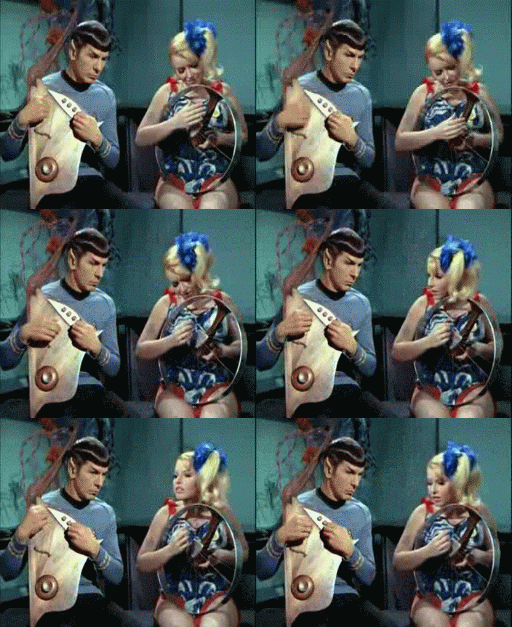


 to the
 , you can see the change. In the
 he learned that a machine cannot experience the joy of touch, of physically connecting with others. And that experience changed him. Spock learns. He grows. He became comfortable with the balance between his emotional human half and his rational Vulcan self.

 , Spock has mellowed significantly. He’s literally a wise old man, a sage who’s extremely comfortable in his own ears, so much that, if you watch closely, he pretty nearly smiles at the end of the film. Fascinating.






 " (named after Isaac Asimov's
 ) appears in the anthology